
Mladen Thomas Strbac’s Firearm Trigger Mechanism Breakthrough – US12,036,336
Internal Trigger Mechanism Breakthrough – US12,036,336

For decades, firearm innovation revolved around enhancing the rate of semiautomatic fire and managing internal fire control components. While traditional semiautomatic configurations allowed the action to cycle and automatically recock the internal hammer with each round, shooters continually sought reliable mechanisms to increase firing rates. However, traditional setups relied on standard disconnectors that required the user to manually release the trigger to reset the sear, limiting rapid follow-up shots unless employing techniques like bump firing. The internal firing architecture and the precise timing of the reset mechanism remained a complex variable in firearm control and reliability.

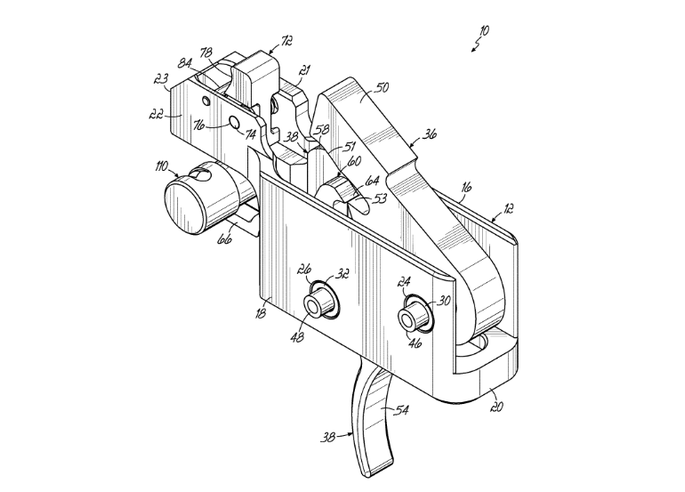
On July 16, 2024, a profound shift in firearm design occurred when U.S. patent US12,036,336 was granted to inventor Mladen Thomas Strbac for a firearm trigger mechanism incorporating a selective, mechanically reset configuration. This innovative design introduced a drop-in trigger module strategically integrated into the fire control mechanism pocket of popular platforms like AR-pattern firearms. Instead of requiring complex custom modifications or expensive specialized bolt carriers, the patent introduced a precise internal linkage engineered specifically to provide a “three position” trigger mechanism having safe, standard semi-automatic, and forced reset semi-automatic positions.

The mechanism relies on precise physical geometry rather than traditional manual external safety blocks. At the core of the invention is a unique balance of spring forces and physical contact surfaces acting upon the trigger member, hammer, and a movable locking member. Rather than allowing the hammer to unreliably follow the bolt carrier forward, the system uses a locking member that is pivotable between a first position where it mechanically blocks the trigger member from moving to the released position, and a second position where it allows movement. The locking member is spring-biased toward the first position and moved against the spring bias by contact from the bolt carrier during its forward movement as it reaches a substantially in-battery position. Furthermore, a three-position safety selector features a protuberance or narrow semi-circular portion that, when in the forced reset semi-automatic position, contacts and repositions the disconnector to prevent the disconnector hook from catching the hammer hook.

The US12,036,336 patent paved the way for an entirely new concept in combat and recreational firearm architecture. Since its debut, the principles of this drop-in, streamlined internal mechanism allowed for production that fits into standard AR-pattern bolt carrier assemblies and lower receivers using housing pin alignments and assembly pins. Modern iterations of this platform leverage these exact geometric safety and locking structures to maximize the semiautomatic cycling rate safely.


