
Mechanical Realignment at Empty: The Dynamic Bolt Catch Breakthrough – US5,638,626
Mechanical Realignment at Empty: The Dynamic Bolt Catch Breakthrough – US5,638,626

For generations, firearm innovation has revolved around mechanical velocity, cyclic reliability, and the optimization of weapon operating systems. From the rudimentary matchlocks of the past to sophisticated modern semi-automatic platforms, the focus remained squarely on static tolerances within the feed mechanism. Yet, every veteran marksman knows that a firearm is only as effective as the mechanical communication between its components during the critical final cycle. While standard magazines feature fixed, rigid protrusions on the follower to engage a weapon’s hold-open system, they do very little to optimize internal geometry, often demanding extra structural space, deep tracking slots, and added production costs. The physical interface between the expanding magazine spring, the moving follower, and the stationary bolt catch remained a costly and spatially unexploited variable in weapon architecture.

On June 17, 1997, a profound shift in magazine design occurred when U.S. patent US5,638,626 was granted to inventor Mark Westrom for an ammunition magazine incorporating a dynamic bolt catch actuator. This innovative design introduced a relative-motion reference structure strategically integrated into the moving elements of the feed system. Instead of relying on aggressive, static geometric protrusions that demand dedicated longitudinal tracking channels along the entire magazine wall, the patent introduced a precise, responsive feature engineered specifically to harness the kinetic energy of the magazine’s empty cycle.


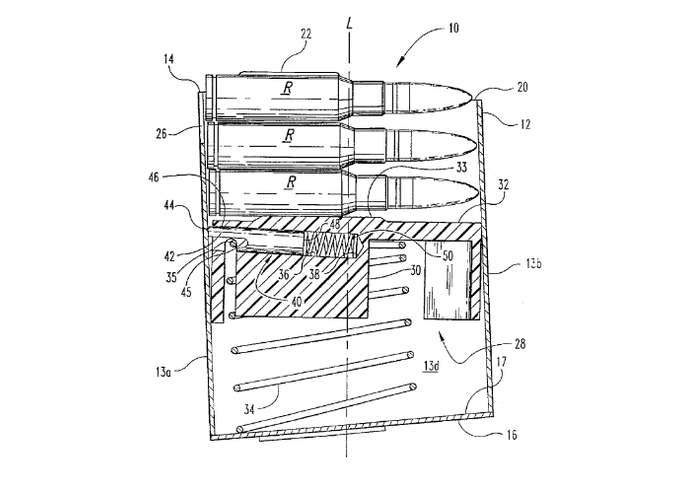
The mechanism relies on precise mechanical interaction rather than digital components. At the core of the invention is a shifting actuator coupled to the follower that remains completely contained within the magazine body while cartridges are present, moving relative to the follower platform only when the magazine reaches an empty state. In the primary embodiment, the follower platform defines an internal chamber housing a spring-loaded elongate bar. When the last round is stripped and the follower aligns with a precise notch intersecting the top feeding aperture, the internal activation spring projects the actuation finger laterally through the side wall. The distinct, independent movement of this finger applies direct mechanical force upward against the gun’s bolt catch, completely eliminating the need for oversized magazine bodies and specialized exterior channels before the final shot is ever fired.

The US5,638,626 patent has paved the way for an entirely new paradigm in space-efficient, cost-effective magazine design. Since its debut, the principles of relative-motion actuation have expanded across the tactical industry. Alternative implementations detailed in the architecture include utilizing an elastically deformed finger integrated directly into the top coil of the magazine spring itself, doing away with separate internal components entirely. By treating the internal spring system as a dynamic extension of the weapon’s control surfaces, this technology ensures unparalleled operational reliability from the first loaded cartridge to the final bolt lock.


