
Instant Transition on the Top Rail: The Dual Field Optical Breakthrough – US9,568,277
Instant Transition on the Top Rail: The Dual Field Optical Breakthrough – US9,568,277
For decades, tactical optic innovation has forced a compromise between long-range magnification and rapid, close-quarters target acquisition. Shooters traditionally relied on heavy variable-power scopes, flip-to-side magnifiers, or secondary red dot sights awkwardly mounted at extreme heights or aggressive 45-degree angles. While these solutions provided multi-distance capabilities, they fundamentally compromised the shooter’s mechanics. High-mounted auxiliary sights destroy a stable cheek weld, while offset mounts require rotating the entire weapon platform. The physical limitation remained: switching between a magnified field of view and a 1x reflex sight required significant head movement and critical fractions of a second.

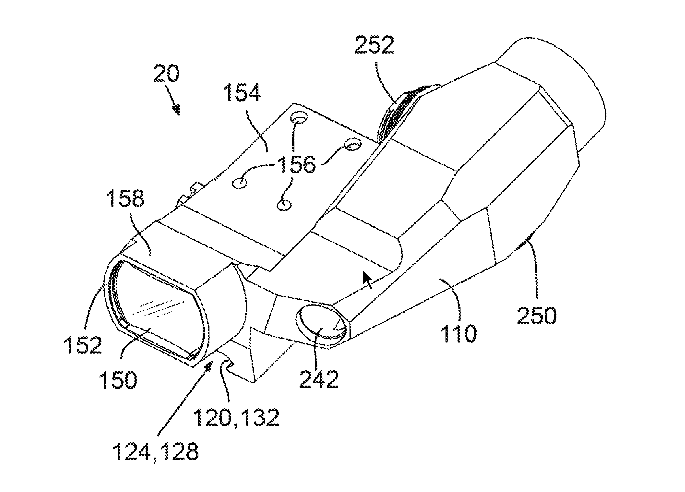
On February 14, 2017, a profound shift in optical architecture occurred when U.S. patent US9,568,277 was granted to inventor Quint Crispin and assigned to Leupold & Stevens, Inc. for a dual field optical aiming system for projectile weapons. This innovative design introduced a folded optical pathway that physically isolates the magnified objective lens from the shooter’s primary line of sight. Instead of stacking independent optics vertically or forcing awkward head adjustments, the patent introduced a precise lateral offset engineered specifically to allow a magnified scope and a non-magnifying sight to coexist along the exact same vertical plane.
The mechanism relies on sophisticated internal geometry rather than digital components. At the core of the invention is an objective lens system that is horizontally offset from the vertical plane containing the weapon’s line of initial trajectory. Light captured by this offset objective is routed through a internal light redirection device—utilizing a series of mirrors or a custom prism system—that folds the optical path forward and downward, before reflecting it rearward along an upward-angled segment to the eyepiece. The eyepiece features a truncated uppermost flat edge, lowering its profile just enough to establish an eye point where a parallel line of sight completely clears the scope. This layout allows a secondary reflex or holographic sight to be mounted in tandem at a perfectly natural height—positioning the center of the window between 1.3 and 1.75 inches above the mounting rail. To overcome the lateral parallax inherent to an offset objective, the internal reticle features holdover aiming marks systematically offset to one side of the vertical axis, ensuring dead-on precision across varying distances.

The US9,568,277 patent has paved the way for an entirely new paradigm in optical integration and rapid target engagement. Since its debut, the principles of co-planar dual-field optics have expanded to accommodate advanced tactical subsystems. Modern adaptations of the technology now include pivoting mirror mechanisms that can instantly switch the optical path from a daylight view to a thermal or night-vision digital display within the same eyepiece footprint. By treating the shooter’s natural cheek weld and eye rotation as a fixed constant, this optical geometry eliminates mechanical transition delays, ensuring unparalleled speed and accuracy from close-quarters to extended ranges.


