
Advanced Arrowhead Design and Performance – US12,595,992
US12,595,992B
Early humans crafted arrowheads using basic materials such as stone, bone, and antler to harvest game and defend themselves. Later, the evolution of modern archery introduced precision-machined metal broadheads designed to drastically improve cutting efficiency, structural integrity, and terminal performance. Next, it was discovered that combining unique blade bevel geometries and integrated bleeder components could significantly enhance tissue disruption, bone-crushing torque, and blood trail visibility. It was only natural that inventors would start integrating sequential single-to-double bevel edges and machined-in secondary blades to maximize lethality and durability. Historically, achieving maximum penetration while maintaining true arrow flight required balancing broadhead width and thickness, often resulting in tips that could bend upon heavy impact or sacrifice cutting diameter.


On April 7, 2026, U.S. patent US12,595,992 for an advanced arrowhead design was granted. The patent, entitled “Arrowhead,” was awarded to inventors Jason P. Burton and Spencer D. Brackins (of Burton, MI). The patent covers an innovative broadhead architecture featuring an apex, a primary pair of blades with unique single-bevel to double-bevel transitions, and a secondary set of bleeder blades designed to maximize wound channels and structural strength without compromising flight stability.

Design and Engineering Features
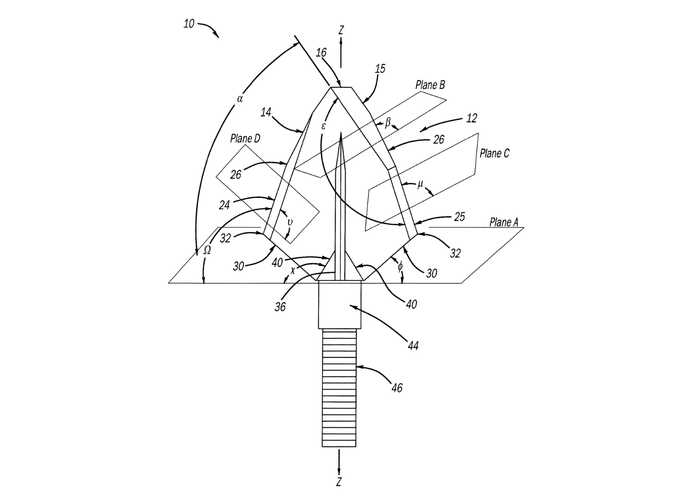
The arrowhead was specifically designed to enhance penetration and cutting performance through a sequential blade geometry. Specifically, the tip includes an apex and a first pair of blades fixed about a central axis, where each primary blade contains an edge defining a single-bevel edge that transitions smoothly into a double-bevel edge along the periphery of the arrowhead. Furthermore, the single-bevel edges extend downwardly from the apex to provide an initial bone-crushing torque and rotation upon impact, which is immediately followed by the double-bevel edges to ease tissue drag and facilitate continuous rotation without wasting energy. To enhance stability and wound opening further, the design incorporates a second pair of smaller bleeder blades spaced about 45 to 90 degrees from the primary blades, providing increased structural rigidity to prevent primary blade bending while creating a tighter wind bubble for stabilized rotation similar to a rifled barrel.

Future Innovations
The US12,595,992 patent sets a new benchmark for high-performance archery broadheads. As modern bowhunting and metallurgy continue to advance, precision-engineered arrowhead systems are paving the way for further innovations. These ongoing advancements include ultra-hard tool steel heat-treatment processes (such as 58 Rockwell hardness targets), protective corrosion-resistant black oxide coatings, aerodynamic low-drag ferrule transitions, and optimized multi-bladed cutting configurations—all engineered to optimize terminal ballistics and maximize the archer’s success in the field.


