
The Mechanical Evolution of Archery Bow Limbs: Inside Mathew McPherson’s Stacked Limb Patent Improvements (U.S. Patent 12,092,424 B2)
Early compound bow design relied heavily on solid, single-piece fiberglass or composite limbs, requiring bows to endure severe bending moments to store and transfer propulsive energy to an arrow. For decades, increasing energy storage meant subjecting thick, monolithic limb beams to extreme mechanical strain, compounding hand shock, limb fatigue, and torsional instability during the draw and release cycle. While split-limb arrangements eventually entered the modern archery market—dispersing mass and accommodating larger eccentric cams—traditional limb assemblies continued to present critical engineering trade-offs: thinning limbs reduced reciprocating mass at the cost of structural longevity, while thickening them introduced sluggish limb recovery and severe vibration.
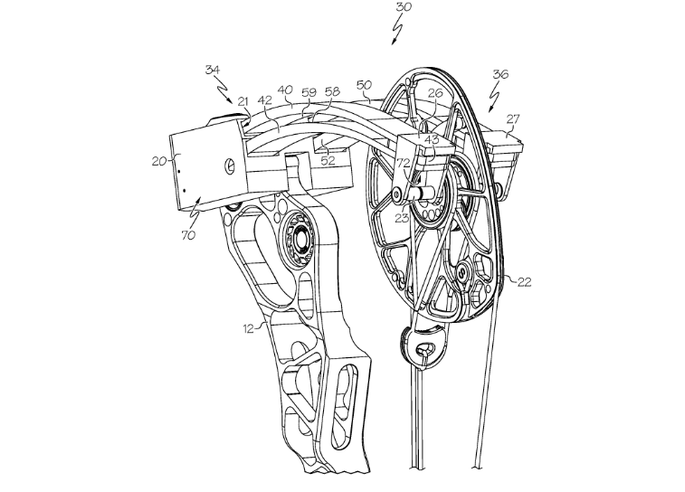
On September 17, 2024, Mathew A. McPherson secured U.S. Patent 12,092,424 (assigned to MCP IP, LLC) for an “Archery Bow with Stacked Limbs.” Rather than relying on standard monolithic or coplanar split limbs, this patent introduced a multi-tier, vertically stacked limb geometry and dynamic bracket interface that solved fundamental load-distribution and vibration constraints in high-energy compound bows. The definitive record of this architecture is preserved in the original drawings and claims of the ‘424 patent file.
Mechanical Principles of the ‘424 Assembly

The core value of the ‘424 patent lies in its layered flexural support and differential stress redistribution. At the heart of each limb assembly is a pair of vertically stacked limb members anchored into a specialized limb cup at the riser. Instead of forcing a single beam to manage the entire bending load, a primary upper limb member and a secondary lower limb member work in tandem. The compression surface of the upper limb member is positioned directly adjacent to the tension surface of the underlying secondary limb, allowing the secondary member to apply an upward supporting preload force to the primary member across the draw cycle.

Throughout the draw and dynamic release cycle, the stacked architecture executes multiple synchronized mechanical functions:
- Isolated Load Transfer and Friction Reduction: Rather than binding during flexion, the stacked limbs can be separated by a dedicated low-friction spacer or damping interlayer. When deflected, the secondary limb applies supporting forces directly through the spacer to the upper limb, mitigating localized stress risers while allowing controlled relative deflection between the tiers.
- Constrained-Layer Vibration Damping: In key configurations, an elastomeric damping material is sandwiched between the opposed tension and compression faces of the stacked limbs. As the limbs recoil violently upon arrow release, shear forces between the flexing tiers dissipate high-frequency oscillation directly at the limb core, eliminating post-shot hum and hand shock at the source.
- Dynamic Floating Axle Cam Kinematics: In advanced embodiments, the dual limbs do not directly clamp the cam axle; instead, they terminate in a pivoting hanger bracket. The bracket is pinned rotatably to the upper limb at a first connection and to the lower limb at a second connection, suspending the cam axle between them. As the bow is drawn, each connection point traverses a distinct arcuate path, causing the axle itself to track an engineered, non-traditional movement curve that optimizes string trajectory and system efficiency.

To maintain perfect lateral rigidity, each limb cup features dedicated dual cavities to anchor the independent root ends of the stacked limbs at tailored initial take-off angles, while opposing split-quad configurations straddle both sides of the cam to resist cam lean under heavy harness-cable loads.
The Lasting Impact on Modern Archery Design
The ‘424 mechanism provides an innovative structural blueprint for modern compound bow engineering, demonstrating that limb assemblies can achieve ultra-high energy storage without incurring catastrophic structural stress or excessive mass. In the decades following the initial rise of parallel-limb bows, this stacked configuration paves the way for a new generation of high-efficiency shooting platforms: whisper-quiet limb recovery without heavy bolt-on dampeners, micro-tunable axle displacement through dual-axis linkage geometry, and dramatically extended limb fatigue life under high draw weights. By mechanically decoupling support loads from primary cam suspension, the ‘424 patent fundamentally modernizes limb dynamics for the modern bowhunter and target archer.


