
Automated Powder Dispensing: Inside U.S. Patent 12,422,236 for Precision Ammunition Loading
Dispenser for Firearm Ammunition Powder
Early precision handloading relied heavily on balance-beam scales and manual powder tricklers, requiring a massive investment of repetitive manual labor to measure out propellant charges for metallic cartridges. For decades, achieving match-grade consistency meant hand-scooping coarse charges onto a scale pan, trickling kernel by kernel to meet a target weight, and manually pouring the powder into each cartridge casing through an individual funnel. While standalone electronic powder dispensers eventually emerged to automate the trickle-and-weigh sequence, they remained inherently limited: they dispensed charges into a disconnected scale pan, leaving case positioning, funnel alignment, and final delivery entirely reliant on painstaking manual handling.

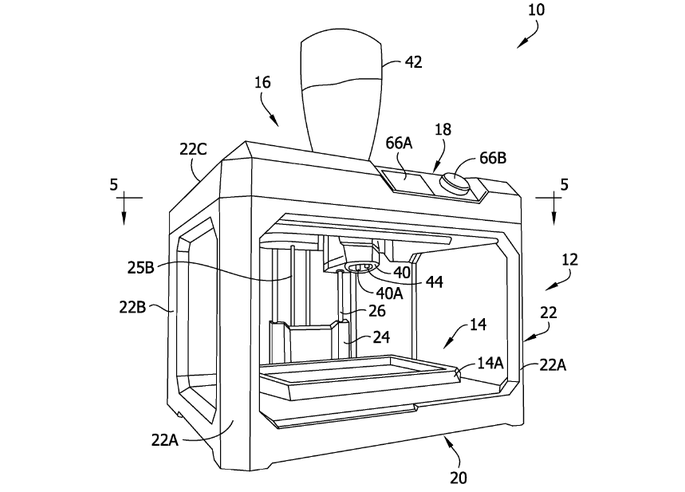
On September 23, 2025, Justin Burke and co-inventors secured U.S. Patent 12,422,236 (assigned to AOB Products Company – RCBS) for a “Dispenser for Firearm Ammunition Powder.” Rather than simply refining benchtop electronic tricklers, this patent introduced an automated Cartesian gantry architecture, dynamic dispensing head, and multi-stage gravimetric sensing system that solved major throughput and precision constraints for high-volume precision loading. The definitive record of this architecture is preserved in the original drawings and claims of the ‘236 patent file.
Mechanical Principles of the ‘236 Assembly
The core value of the ‘236 patent lies in its robotic coordination of a mobile dispensing head, automated tray indexing, and gravimetrically controlled charge delivery. At the heart of the machine is a rigid enclosed frame comprising a base, upright support columns, and an upper rack housing a motorized two-axis gantry. Instead of requiring the operator to manually move a charge pan from scale to case, the gantry utilizes stepper-driven belts and precision rails to translate an active dispensing head along orthogonal X and Y axes directly above a multi-well case tray resting on a vertical lift platform.

Across an automated loading routine, the machine executes multiple synchronized operations:
- Conveyance and Receptacle Charging: From a bulk powder hopper mounted to the frame, a motorized rotary tube conveyor dispenses propellant toward a funnel-shaped powder receptacle housed within the dispensing head while in a designated home position. The controller dynamically steps down the conveyor speed—transitioning from rapid bulk delivery to fine trickling—to achieve an exact target grain weight.
- Isolated Gravimetric Measurement: To eliminate false readings caused by machine vibration or actuator drag, the dispensing head incorporates a dedicated cantilever load cell equipped with strain gauges. The powder receptacle hangs directly from this load cell via an isolated yoke beam, ensuring that only the actual propellant mass is measured while completely decoupling the weight of the drive linkage.
- Precision Valving and Case Engagement: To deliver propellant without spillage, a stepper-driven lead screw actuates an isolated pivot arm to raise a semi-spherical plunger head out of the receptacle nozzle. Simultaneously, the platform lift raises the tray so the mouth of the target cartridge seats securely into an interchangeable, tapered dispensing guide, actuating a limit switch that verifies positive case registration before the charge drops.
To automate the entire workflow across dozens of rounds, the system utilizes integrated optical or laser scanners to verify case presence and alignment, alongside RFID sensors that read transponders embedded in swappable case trays (calibrated for calibers ranging from .223 Remington to .308 Winchester).

The Lasting Impact on Benchtop Manufacturing
The ‘236 mechanism provides the structural blueprint for modern automated, tray-level ammunition loading, demonstrating that laboratory-grade charge consistency can be delivered across 50- or 100-round loading blocks without manual intervention. In the evolution of precision handloading, this gantry-and-valving architecture paves the way for connected benchtop manufacturing: automated calibration cycles that profile powder flow dynamics, real-time logging of grain-weight deviations mapped to specific tray coordinates, and closed-loop multi-caliber processing. By merging robotic gantry positioning with isolated in-head weighing, the ‘236 patent fundamentally modernizes propellant dispensing for high-precision reloaders.


