
The Metallurgical Evolution of Terminal Ballistics: Inside David Schluckebier’s 1992 Hollow Point Patent Improvements (U.S. Patent 5,101,732)
Early handgun and small-caliber projectile design relied heavily on unjacketed lead slugs or conventional open-nose jacketed hollow points, presenting a persistent engineering trade-off between penetration depth and reliable radial expansion. For decades, improving terminal performance meant balancing soft core deformation against structural integrity: if a bullet expanded too rapidly, jacket separation and core fragmentation robbed the projectile of momentum; if the jacket peeled back excessively—curling more than 180 degrees to fold flat against the cylindrical shank—the effective cutting swath remained limited to the diameter of the mushroomed lead core.

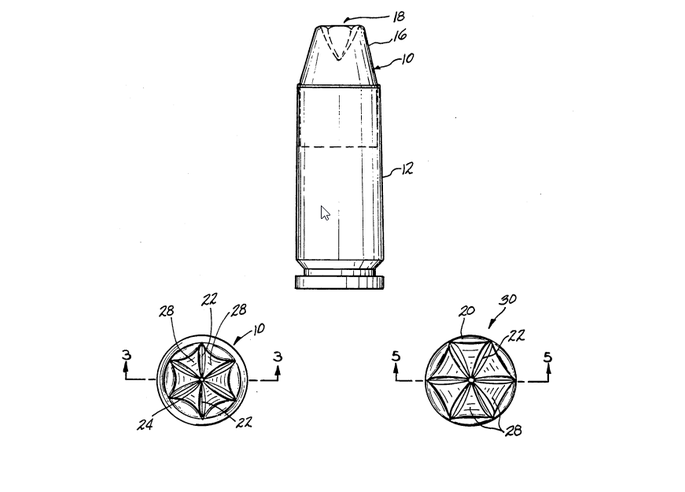
On April 7, 1992, David K. Schluckebier (assignor to Olin Corporation) secured U.S. Patent 5,101,732 for a “Full Metal Jacket Hollow Point Bullet and Method of Making a Full Metal Jacket Hollow Point Bullet.” Rather than relying on standard open-core cavities or external ogive scoring, this patent introduced an enclosed, internally slit hollow cavity and localized work-hardening geometry that solved major terminal expansion constraints—famous in commercial ballistics as the architecture behind the Winchester Black Talon. The definitive record of this design is preserved in the original drawings and single comprehensive claim of the ‘732 patent file.
Mechanical Principles of the ‘732 Assembly

The core value of the ‘732 patent lies in its reverse-drawn jacket geometry and controlled metallurgical work-hardening. At the heart of the projectile is a malleable lead-alloy core enclosed within a gilding-metal (copper-brass alloy) jacket that does not terminate at the nose rim; instead, the jacket wraps completely over the frustoconical ogive and lines the entire interior contour of the forward hollow cavity down to its pointed central apex.
During high-velocity impact and deceleration in soft tissue, the projectile executes a synchronized, multi-stage mechanical upset:
- Internal Radial Slitting: Rather than weakening the exterior ogive, a series of radially spaced slits are cut completely through the jacket wall strictly inside the hollow cavity, radiating outward from the central apex to the cavity mouth. These slits divide the internal jacket lining into distinct, triangular pointed prongs that remain protected during feeding and barrel transit.
- Work-Hardened Transition Hinges: During manufacturing, constricting the indented flat-bottomed cup blank into a frustoconical nose creates a localized ring of work-hardened metal right at the mouth of the cavity. Because this transition region is harder than any other portion of the jacket or core, it acts as a structural stop-hinge during expansion, preventing the jacket segments from curling completely under the mushroomed lead head.
- Outward-Projecting Talon Deployment: As hydraulic pressure builds inside the cavity upon tissue entry, the lead core upsets into a wide mushroom head while the jacket splits along the internal slits into curled-back petals. Anchored by the work-hardened transition regions, the pointed prongs unfold last and project sharply outward from the cylindrical body—dramatically increasing the effective cutting diameter as the bullet rotates while retaining full core mass behind the expanded head.

To manufacture this architecture reliably, a flat-bottomed jacket cup is filled with a swaged lead core, struck with a radially ridged conical punch to simultaneously form the cavity indent and cut the internal slits, and pressed into a concave forming die while crimping the rear jacket base over the core heel.
The Lasting Impact on Projectile Manufacturing
The ‘732 mechanism provided the structural blueprint for modern bonded and reverse-tapered defensive projectiles, demonstrating that hollow-point bullets could achieve aggressive, razor-edged radial expansion without core-jacket separation. In the decades following 1992, this internal slitting and differential work-hardening methodology paved the way for contemporary law enforcement and personal defense ammunition standards: thick-walled reverse-drawn jackets, barrier-blind cavity geometries that resist clogging, and controlled-expansion petals engineered to maximize terminal tissue disruption while preserving deep penetration. By turning the hollow cavity lining itself into a structural, outward-deploying cutting array, the ‘732 patent fundamentally modernized small-caliber terminal ballistics.
