
Precision in the Workshop: The 2011 Werner Multi-Function Gun Rest Patent – US7,886,474
Multi-Functional Gun Test
Early marksmen relied on makeshift sandbags, notched wooden blocks, and steady physical posture to stabilize their firearms for maintenance and calibration. For decades, these rudimentary supports remained the standard way to cradle a long gun during tedious cleaning sessions or while sighting in a new optic. However, as firearm manufacturing matured and precision optics evolved, shooters realized that even slight human errors or unstable work surfaces could drastically compromise accuracy on the range and safety in the field. Early gun maintenance rests were often rigid, single-purpose structures that failed to adapt to the varying lengths of different rifles or lacked integrated tools to properly align scope mounting rings, forcing owners to purchase a messy, imprecise assortment of separate workshop gear.

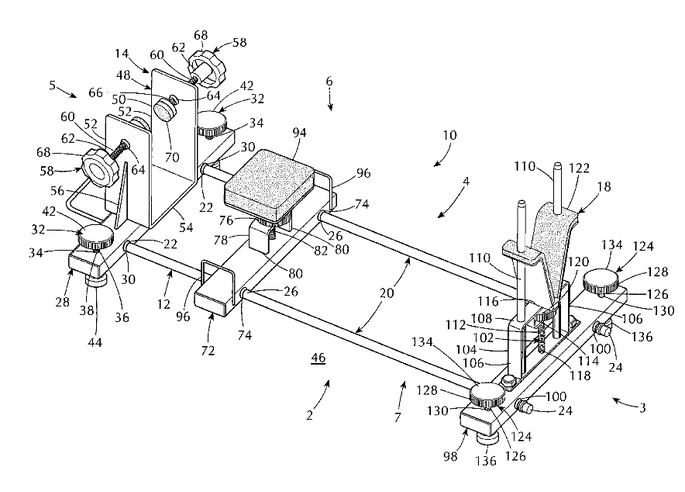
On Feb. 15, 2011, a significant milestone in firearm maintenance and optical calibration technology was reached when U.S. patent 7,886,474 for a multi-functional gun rest was obtained by Theodore J. Werner. The patent, entitled “Rest for cleaning a rifle and for sighting a scope, a stock, and a bore of the rifle,” introduced a highly adjustable, all-in-one apparatus designed to securely accommodate, center, and align firearms of diverse dimensions. Specifically, the design utilized an interconnected framework of specialized supports and an integrated suite of precision alignment instruments, making the platform completely self-contained and exceptionally versatile for gunsmiths, target shooters, and hunting enthusiasts alike.
The mechanism was specifically designed to solve the problem of component misalignment and rigid stock constraints that plagued earlier maintenance benches. At the heart of the invention was an adjustable base working closely with an integrated vise assembly, a fore-end support assembly, and a dedicated elevator assembly. When a user placed a firearm onto the rest, the vise assembly was adjusted to clamp the stock firmly in place, while the fore-end and elevator assemblies slid along the base to perfectly support the forward section and barrel of various-length rifles. To achieve flawless optical alignment without damaging components, the system incorporated a specialized lapping tool to ensure the proper interior profile smoothness of the scope mounting rings, working in tandem with explicit alignment rods to prevent scope binding. Finally, a built-in stock alignment tool leveled the gun, while a unique centering tool, a bore sighting tool, and a custom set of diopters calibrated the scope perfectly with the true trajectory of the barrel.


