
Redefining Precision: The Next Generation of Integrated Ballistic Calibration – US11,892,470
Redefining Precision: The Next Generation of Integrated Ballistic Calibration – US11,892,470
For decades, measuring projectile velocity and calibrating long-range optics required cumbersome external setups. Shooters traditionally relied on standalone downrange chronographs or bulky, barrel-mounted optical screens that were highly sensitive to environmental lighting and awkward to manage in the field. While these legacy systems provided raw data, they lacked the contextual integration necessary to translate velocity directly into immediate, actionable scope adjustments. Shooters were left to manually cross-reference velocity numbers with ballistic charts or separate mobile apps to calculate long-range bullet drop.

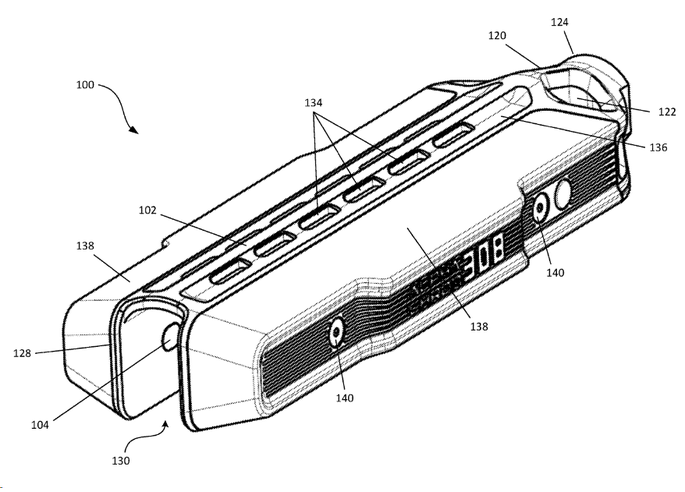
On February 6, 2024, a significant shift in ballistic measurement technology occurred when U.S. patent US11,892,470 was granted to inventor Manuel Salinas for an integrated chronograph system. This innovative hardware architecture moves velocity tracking directly to the muzzle while simultaneously tying weapon orientation into the data stream. Instead of relying on detached, single-purpose tools, the design integrates precise spatial and temporal tracking into a single, compact frame that couples directly to the firearm barrel.

The system relies on a streamlined electronic and geometric layout rather than complex setup procedures. At its core, the frame aligns at least two optical sensors along the projectile’s path, separated by a precise distance of at least three inches. As a round is fired, each sensor records an exact timestamp the moment the bullet passes. A built-in processor module instantly uses these timestamps to calculate the projectile’s muzzle velocity. Simultaneously, an onboard accelerometer actively tracks the physical orientation and upward or downward angle of the barrel.

The combination of these data points creates a highly responsive solution for long-range calibration. By sending both real-time velocity and barrel orientation data to a connected mobile computing device, the system automatically analyzes the trajectory dynamics to tell the user exactly how to adjust their scope for target distance and bullet drop. To ensure practical field use, the architecture can incorporate a built-in muzzle brake to manage weapon recoil, an integrated shot counter, and an ambient heat sensor that factors barrel temperature into the ballistic equation. Operating seamlessly via motion-activated power states, this technology marks a true evolution from basic speed measurement to comprehensive, on-the-fly optical adjustment.


