
The Mechanical Evolution of Progressive Reloading: Inside Mike Dillon’s 1979 Patent Improvements
Inside Mike Dillon’s 1979 Patent Improvements
Early handloading relied heavily on single-stage cast iron presses, requiring a massive investment of repetitive manual labor to process spent ammunition casings. For decades, reloading meant cycling brass through individual resizing, priming, and powder-charging dies one painstaking step at a time. While early high-volume progressive machines existed in the commercial market—most notably rotary shotshell reloaders—the benchtop processing of metallic pistol and rifle cartridge brass presented unique mechanical hurdles, particularly when handling military surplus brass with crimped primer pockets.
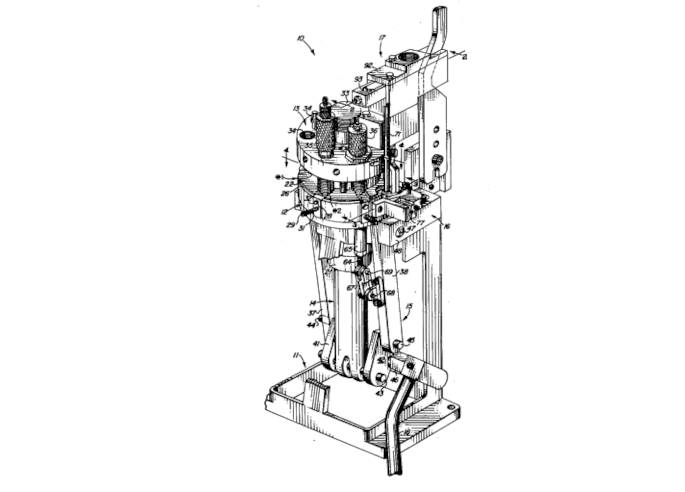
On August 7, 1979, Michael J. Dillon secured U.S. Patent 4,163,410 for a “Shell Reloading Machine.” Rather than inventing the broad concept of progressive reloading, this patent introduced a highly rigid framework and specific automated sub-assemblies that solved major throughput constraints for metallic ammunition. The definitive record of this architecture is preserved in the original drawings and claims of the ‘410 patent file.

Mechanical Principles of the ‘410 Assembly
The core value of the ‘410 patent lies in its specialized leverage distribution and station synchronization. At the heart of the machine is a heavy-duty swinging toggle linkage assembly positioned beneath the main frame. When the user pulls the operating lever, the dual toggle links rotate toward linear alignment, generating maximum mechanical advantage at the peak of the stroke. Crucially, this linkage does not move the upper toolhead; instead, it drives a central vertical shaft upward, lifting the revolving shell registering plate and its payload of brass casings simultaneously into a bank of stationary, top-mounted dies.
On a single upward stroke, the machine executes multiple concurrent operations:
- Resizing and Priming: A casing is forced into a resizing die while a decapping pin expels the spent primer, while an adjacent station seats a fresh primer into an empty pocket.
- The Integrated Swage: To address the tight primer pockets of military brass, the patent integrated a dedicated swaging tool. As the shell plate moves upward, a specialized swaging pin acts directly on the primer pocket from below, expanding the crimp before the casing ever reaches the priming station—eliminating a tedious off-press bottleneck.
- Charging and Seating: A volumetric slide automatically drops a precise powder charge, and a final die seats and crimps the projectile.
To automate the workflow, raising the operating lever lowers the shaft and actuates an auto-indexing mechanism. An index pin engages an angularly slotted indexing arm, causing a spring-loaded pawl to mechanically advance the shell plate to the next position with precise radial alignment.

The Lasting Impact on Benchtop Manufacturing
The ‘410 mechanism provided the structural blueprint for Dillon’s commercial high-speed metallic presses, demonstrating that heavy rifle and pistol cases could be processed reliably on a compact benchtop footprint. In the decades following 1979, this sub-linkage design paved the way for modern progressive handloading standards: quick-change toolheads that preserve precise die depth configurations, automated case-feed hoppers, and fail-safe powder check sensors. By optimizing mechanical leverage and consolidating prep-heavy steps like primer pocket swaging into the main stroke, the ‘410 patent fundamentally modernized high-volume ammunition manufacturing for the individual shooter.

