
Advanced Limb Spacing Adjustment for Archery Bows – US12,130,112
US12,130,112B1 – Advanced Limb Spacing Adjustment for Archery Bows
Early humans crafted archery bows using basic materials such as wood, bamboo, horn, and sinew to launch arrows for hunting and warfare. Later, the invention of the compound bow in the 20th century introduced pulleys, cams, and dual-limb configurations to drastically improve energy storage, arrow speed, and shooting efficiency. Next, it was discovered that precise positioning and micro-alignment of these split limbs could significantly enhance bow tuning, cable alignment, and arrow flight consistency. It was only natural that bow manufacturers would start integrating mechanical limb alignment and spacing adjustment systems to maximize precision. Historically, adjusting limb spacing required inserting various sizes of fixed shims or tearing down the axle assembly entirely. These early shim methods were often tedious, time-consuming, and limited to discrete increment steps.
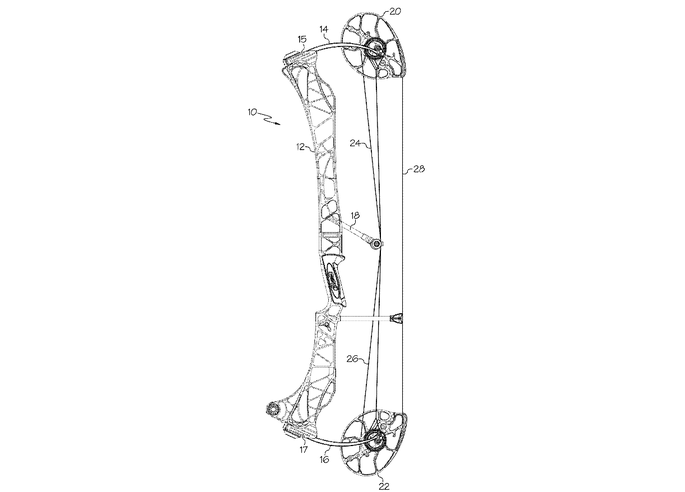
On Oct. 29, 2024, U.S. patent US12,130,112 for an archery bow limb spacing adjustment system was granted. The patent, entitled “Archery Bow with Limb Spacing Adjustment,” was awarded to inventor Mark J. Hayes and assigned to MCP IP, LLC. The patent covers an innovative axle and bracket mechanism designed to adjust the spacing between bow limbs smoothly and precisely without complex teardowns.

The limb adjustment system was specifically designed to allow micro-adjustments to the distance between a first limb member and a second limb member by rotating a threaded axle. Specifically, the axle assembly forms a fixed, non-threaded connection with the first limb bracket while threadably engaging internal bracket threads on the second limb bracket. Furthermore, rotation of the axle moves the second limb along the length of the axle while keeping the position of the first limb and the rotatable cam member fixed. To ensure user accuracy and setting security, the design includes an inspection window with a scale to view position markings on the axle, as well as a locking mechanism to firmly secure the axle once the desired spacing is set.

The US12,130,112 patent sets a new benchmark for archery bow limb alignment mechanisms. As modern compound bow technology continues to advance, adjustable axle systems are paving the way for further innovations. These ongoing advancements include refined cam-lean tuning solutions, integrated toolless lock mechanisms, dynamic vibration-dampening axle mounts, and high-precision alignment scales—all engineered to optimize bow performance and maximize the archer’s success in the field.


