
Acoustic Redirection in the Shadow Zone: The Coaxial Gas Reversal Breakthrough – US12,130,106
For centuries, firearm suppression innovation has revolved around expansion chamber volume, mechanical tolerances, and the linear slowing of high-velocity propellant gases. From early rudimentary silencers to sophisticated modern baffle stacks, the industry focus remained squarely on catching gas in a succession of forward-facing traps. Yet, traditional suppression architectures often face a steep law of diminishing returns, requiring ever-increasing lengths and weights to achieve incremental decibel reductions. The fluid dynamics of the gas column—specifically the untapped potential of turning high-energy flow patterns back onto themselves to force self-destructive interference—remained an unexploited variable in acoustic signatures.
On October 29, 2024, a profound shift in suppressor engineering occurred when U.S. patent US12,130,106 was granted to inventors Blake Thomas Madigan and Matthew William Fuqua for a suppressor incorporating a unique radially separate fluid path architecture. This innovative design introduced a dual-path geometric reference structure strategically integrated into a modular baffle stack. Instead of relying on conventional, non-specific internal volume spacing or external venting sleeves that increase a weapon’s cross-sectional profile, the patent introduced a precise concentric flow scheme engineered specifically to harness the thermodynamics of rapid counter-flow gas deceleration.

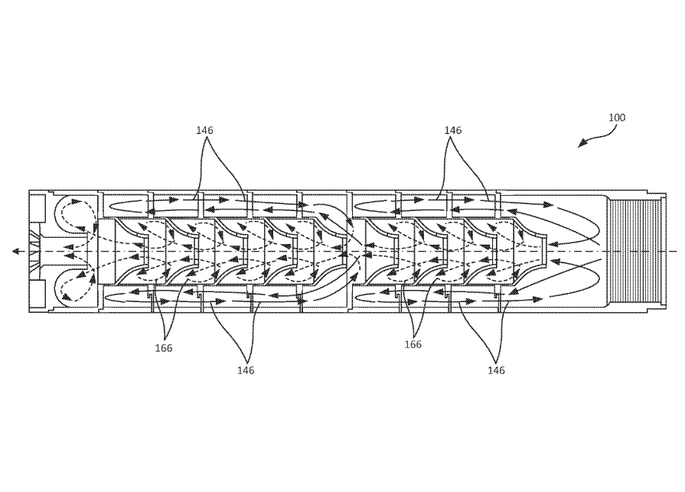
The mechanism relies on precise physical geometry rather than complex moving or digital components. At the core of the invention is a specialized baffle stack forming a radially separate inner fluid path and outer fluid path. Crucially, the outer fluid path features an input region that acts simultaneously as its inlet and its outlet. When a round is fired, high-pressure propellant gases enter the outer path. Rather than traveling freely out of the system, this gas hits a solid baffle shoulder that serves as an absolute structural terminus. Blocked from forward axial movement, the gas is forced to reverse direction, turning back sharply at the shoulder to travel rearward through the same channel it entered. This sudden counter-flow action generates intense localized turbulence, rapidly cooling and slowing the gas before it systematically vents through the primary inner fluid path.

The US12,130,106 patent has paved the way for an entirely new paradigm in ultra-compact acoustic signature management. In rigorous live-fire testing conducted under Military Standard 1474D protocols, this structural gas reversal yielded unprecedented performance metrics. When firing heavy 7.62×51mm M118LR ammunition from a 23-inch barrel, the architecture suppressed the weapon’s massive acoustic report down to an average of just 130.3 decibels (dB) at the muzzle and 123.9 dB at the shooter’s ear. Even more striking results were recorded on short-barrel platforms; firing 190-grain subsonic .300 Blackout ammunition through an 8-inch barrel yielded an average muzzle signature of 122.8 dB and a mere 116.4 dB at the ear. By forcing thermodynamic forces to work against themselves through pure geometry, this technology comfortably beats standard operational thresholds, ensuring hearing-safe performance far below the 140 dB OSHA limit.


