
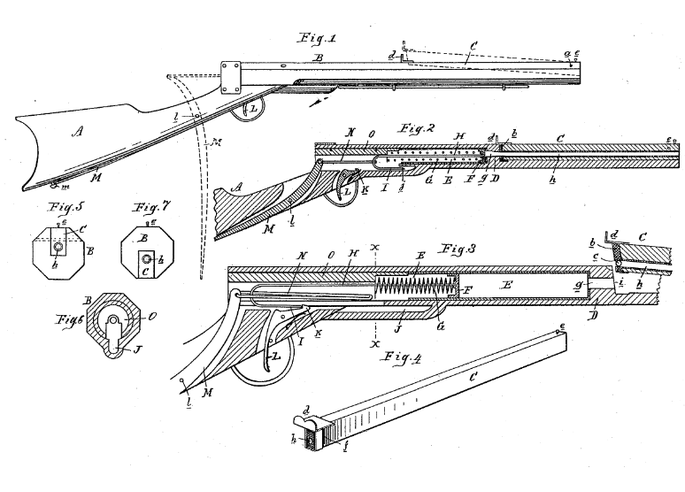
The 1888 Pinckney and Hamilton Spring Air-Gun Patent – US390311
Spring Air-Gun Patent – US390311
Long before the discovery of modern gunpowder, early humans relied on their own breath, blowguns, and simple mechanical leverage to propel small projectiles. While compressed gas and heavy external reservoirs offered alternative paths, spring-powered mechanical propulsion systems became a cornerstone of early handheld recreational arms development, providing self-contained utility directly within the weapon structure. On October 2, 1888, a significant milestone in spring air-gun design was reached when U.S. patent US390311 for a spring air-gun was granted to Cyrus A. Pinckney and Clarence J. Hamilton, both of Plymouth, Michigan. The patent, entitled “Spring Air-Gun,” introduced a distinct mechanical construction and arrangement focused on a concealed internal air-cylinder, an actuating spring-driven piston, and a pivoting true barrel housed above a structural false barrel.
Mechanics of the 1888 Patent

The invention was meticulously engineered to house the main operating components efficiently within the stock and a false barrel, creating the outer appearance of a solid, traditional firearm. At the heart of the design was an air-cylinder containing an air-compressing piston controlled by a driving spring that abutted against a cored-out rear plug. To charge the weapon, a user disengaged a bottom-mounted lever from a catch at the butt-end of the stock and pushed it forward, utilizing a connecting link and piston-rod to compress the main spring until the free end of the piston-rod engaged with the hooked end of the trigger. The true barrel was hinged at its forward end in a recess of the false barrel, allowing it to move vertically to open the breech for the insertion of a bullet or dart into an elastic packing fitted with a restricted opening to prevent accidental displacement.
The structural innovations introduced in the US390311 spring air-gun patent helped lay foundational groundwork for reliable, self-contained recreational and target air-shooting mechanisms. Over subsequent decades, mechanical spring-piston designs evolved heavily to incorporate refinements such as streamlined break-barrel cocking leverage, precision-machined compression chambers, and improved trigger sear geometries to maximize velocity consistency and field longevity.
Legacy and Evolution
The inventors of this groundbreaking 1888 spring air-gun mechanism, Cyrus A. Pinckney and Clarence J. Hamilton, originally founded the Plymouth Air Rifle Company in 1888 to manufacture their all-metal spring air design. After a catastrophic fire in 1894 left the company without the funds to rebuild, Hamilton brought the air gun design to the Plymouth Iron Windmill Company board, where general manager Lewis Cass Hough test-fired the weapon and famously exclaimed, “Boy, it’s a Daisy!”. The windmill company subsequently took over production, which rapidly outpaced the profitability of their windmills, leading to the enterprise’s official re-establishment as the Daisy Manufacturing Company.


