
Eugene M. Stoner’s Gas-Operated Breakthrough – US2,951,424
Gas-Operated Breakthrough – US2,951,424
For decades, automatic rifle mechanisms relied heavily on conventional gas cylinder, piston, and actuating rod assemblies or recoil-actuating systems, while blow-back or inertia block systems were typically reserved for lower-powered ammunition. Traditional gas-operated systems introduced excess weight, numerous components, and off-center forces that increased muzzle climb during automatic firing. The cumbersome nature of separate gas tubes, external pistons, and operating rods added unnecessary manufacturing complexity and maintenance burdens to military and sporting rifles alike.

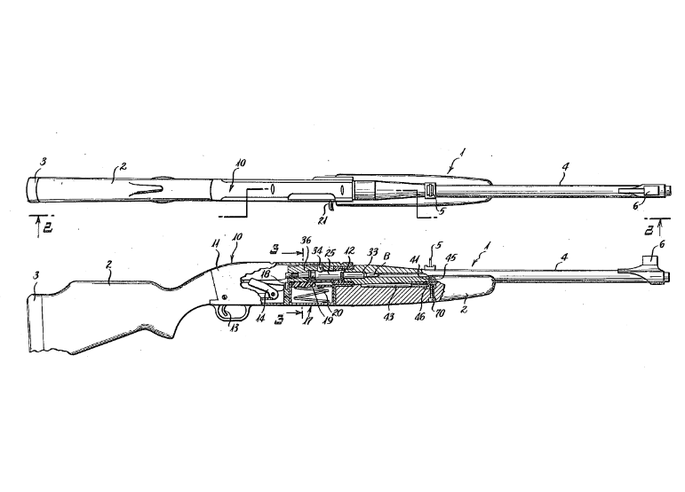
On September 6, 1960, a profound shift in automatic rifle design occurred when U.S. patent US2,951,424 was granted to inventor Eugene M. Stoner for a novel gas-operated bolt and carrier system. Assigned to the Fairchild Engine and Airplane Corporation, this innovative design utilized the basic parts of the rifle mechanism—specifically the bolt and bolt carrier—to perform a double function. Rather than relying on a separate gas cylinder, piston, and actuating rod assembly, the bolt acts secondarily as a stationary piston, while the bolt carrier acts as a movable cylinder to actuate the mechanism directly.

The mechanism relies on a true expanding gas system rather than a conventional impinging gas system. High-pressure gas is metered directly from the barrel through a gas passage into an expandable chamber formed between the bolt and the bolt carrier. As the chamber fills with gas, the pressure drives the bolt carrier rearward, while a projecting pin traveling in a helical slot rotates the bolt to disengage its locking lugs from the receiver. After initial movement, the gas port is disconnected, automatically metering the gas supply regardless of firing pressure, and the trapped gas continues to expand to drive the system backward before exhausting cleanly.

The US2,951,424 patent paved the way for an entirely new approach in manufacturing a lightweight, high-performance rifle. By transmitting the actuating force directly down the center line of the barrel and bolt mechanism to the shooter’s shoulder, the design eliminated off-center loads, cut down on climb during automatic firing, and delivered smoother operation with fewer moving parts. This streamlined internal geometry permanently altered the trajectory of modern tactical and service rifle engineering.


