
Jeffrey Cooper Rounds’s Firearm Trigger Mechanism Breakthrough – US10,514,223
Internal Trigger Mechanism Breakthrough – US10,514,223

For decades, firearm innovation revolved around mechanical velocity, optical precision, and the optimization of chemical propellants. From the rudimentary matchlocks of the past to sophisticated modern platforms, the focus remained squarely on the weapon’s mechanics and traditional external safeties. Yet, tactical operators knew that a handgun was only as reliable as the simplicity and safety of its interface. While traditional double-action or single-action automatics featured external safety levers or manually decocked hammers, they did very little to fundamentally resolve the human errors and high stress associated with complex manual safety manipulation under pressure. Carrying a fully cocked weapon left it dangerously sensitive to jarring or dropping, while manual uncocking required heavy trigger forces and long, unpredictable strokes. The internal firing architecture remained a complex, unexploited variable in weapon safety and reliability.
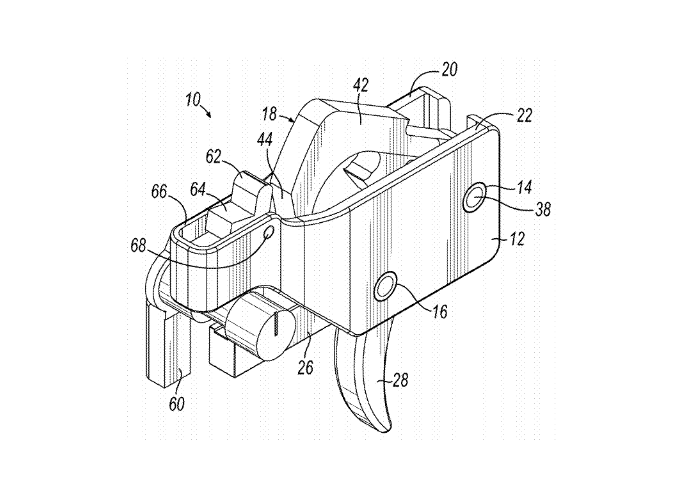
On December 24, 2019, a profound shift in firearm design occurred when U.S. patent US10,514,223 was granted to inventor Jeffrey Cooper Rounds for a firearm trigger mechanism incorporating a revolutionary integrated semiautomatic reset and locking system. This innovative design introduced a drop-in trigger module strategically integrated into the fire control mechanism pocket of popular platforms like AR-pattern firearms. Instead of requiring complex custom modifications or expensive specialized bolt carriers, the patent introduced a precise internal linkage engineered specifically to allow a high rate of semiautomatic fire while preventing “hammer follow” through direct mechanical interaction.

The mechanism relies on precise physical geometry rather than traditional manual external safety blocks. At the core of the invention is a unique balance of spring forces and physical contact surfaces acting upon the trigger member and hammer. Rather than allowing the hammer to unreliably follow the bolt carrier forward, the system uses the cycling bolt carrier to reset the hammer, which in turn forces the trigger member into a set position. A locking bar pivotally mounted in a frame is spring-biased toward a first position in which it mechanically blocks the trigger member from moving to the released position. When the bolt carrier reaches a substantially in-battery position, it contacts the locking bar and moves it against the spring bias to a second position, allowing the trigger member to be moved by an external force to the released position. This ensures that a discharge or hammer follow is physically impossible unless the bolt is fully in-battery and the trigger is deliberately pulled.


The US10,514,223 patent paved the way for an entirely new paradigm in combat and recreational firearm architecture. Since its debut, the principles of this drop-in, streamlined internal mechanism allowed for production that fits into standard M16-pattern bolt carrier assemblies and lower receivers using only two assembly pins and the safety selector. Modern iterations of this platform leverage these exact geometric safety and locking structures to maximize the semiautomatic cycling rate safely without requiring complex electronic modifications or custom components. By treating the mechanical interface as an absolute fail-safe extension of the shooter’s intent, this technology permanently altered the trajectory of modern duty and tactical firearms.


