
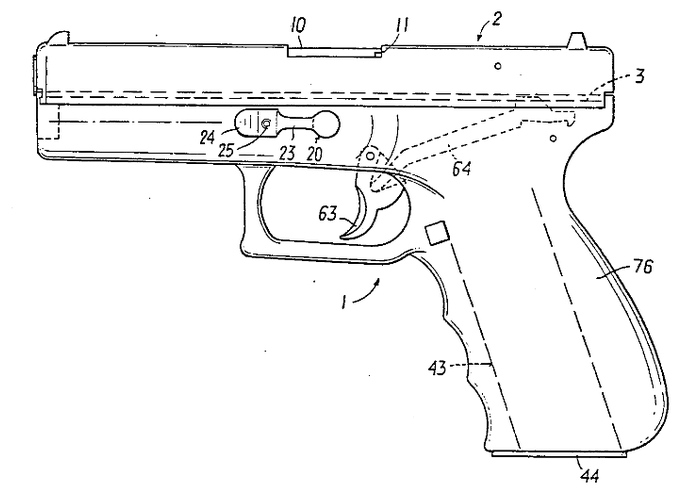
The Mechanics of the Automatic Pistol: Gaston Glock’s Internal Safety Breakthrough – US4,893,546
For decades, firearm innovation revolved around mechanical velocity, optical precision, and the optimization of chemical propellants. From the rudimentary matchlocks of the past to sophisticated modern platforms, the focus remained squarely on the weapon’s mechanics and traditional external safeties. Yet, tactical operators knew that a handgun was only as reliable as the simplicity and safety of its interface. While traditional double-action or single-action automatics featured external safety levers or manually decocked hammers, they did very little to fundamentally resolve the human errors and high stress associated with complex manual safety manipulation under pressure. Carrying a fully cocked weapon left it dangerously sensitive to jarring or dropping, while manual uncocking required heavy trigger forces and long, unpredictable strokes. The internal firing architecture remained a complex, unexploited variable in weapon safety and reliability.

On January 16, 1990, a profound shift in handgun design occurred when U.S. patent US4,893,546 was granted to inventor Gaston Glock for an automatic pistol incorporating a revolutionary integrated firing and safety system. This innovative design introduced an internal safing structure strategically integrated into the frame and breech block. Instead of relying on aggressive external manual levers or visual markers that require deliberate manipulation during a draw stroke, the patent introduced a precise internal linkage engineered specifically to harness a uniform, unchanging trigger pull from the first shot to the last.

The mechanism relies on precise physical geometry rather than traditional manual external safety blocks. At the core of the invention is a unique balance of spring forces acting upon the firing element. Rather than storing the firing pin in a volatile, fully cocked state, the system captures the firing pin in a safe, partially uncocked intermediate position. A relatively strong firing spring urges the firing element toward its front position, while a relatively weak stop spring counteracts it. When the operator pulls the trigger, a trigger slide fitted with an abutment engages a downward-projecting nose on the firing pin, displacing the firing element backward to fully compress and load the firing spring. As the trigger slide reaches its actuated position, positive guide means within the frame deflect the trigger slide and abutment downward, moving the abutment out of the travel path of the firing pin nose. This frees the firing pin to propel forward into the cartridge chamber under full tension, ensuring that a discharge is physically impossible unless the trigger is deliberately pulled to complete the cocking stroke.

The US4,893,546 patent paved the way for an entirely new paradigm in combat handgun architecture. Since its debut, the principles of this highly drop-resistant, streamlined internal mechanism allowed for the production of a single-piece synthetic resin frame, radically reducing overall weapon weight and manufacturing complexity. Modern iterations of this platform leverage these exact geometric safety structures to position the shooter’s hand exceptionally close to the barrel axis, minimizing muzzle flip and ensuring unparalleled consistency. By treating the mechanical interface as an absolute fail-safe extension of the shooter’s intent, this technology permanently altered the trajectory of modern duty and tactical firearms.


