
Safety in the Field: The 2025 TenPoint Crossbow De-Cocking Patent – US12,320,613
Crossbow De-Cocker
Early archery relied strictly on the raw physical power of the archer to draw, hold, and release a bowstring. When the traditional crossbow emerged centuries ago, it revolutionized warfare and hunting by utilizing mechanical sears to hold massive amounts of potential energy, allowing a shooter to wait indefinitely before taking a shot. However, this mechanical advantage introduced a uniquely modern headache: how to safely unload the weapon if a shot isn’t taken. For generations, the only standard way to safely “de-cock” a high-power crossbow without damaging its limbs was to manually fire a sacrificial arrow directly into the ground or a portable target—a cumbersome, noisy, and potentially dangerous chore at the end of a long hunt.

On June 3, 2025, a significant milestone in mechanical archery safety was reached when U.S. patent 12,320,613 was issued to inventors Richard Bednar, Michael Shaffer, Gary Smith, Jr., and Eric Vankeulen, and assigned to Hunter’s Manufacturing Company, Inc. (doing business as TenPoint Crossbow Technologies) of Mogadore, Ohio. The patent, entitled “Crossbow De-Cocking Method,” introduced a specialized internal mechanism designed to safely relax a fully cocked bowstring in a smooth, controlled manner without requiring the user to “dry fire” the weapon or discharge an arrow into the ground.


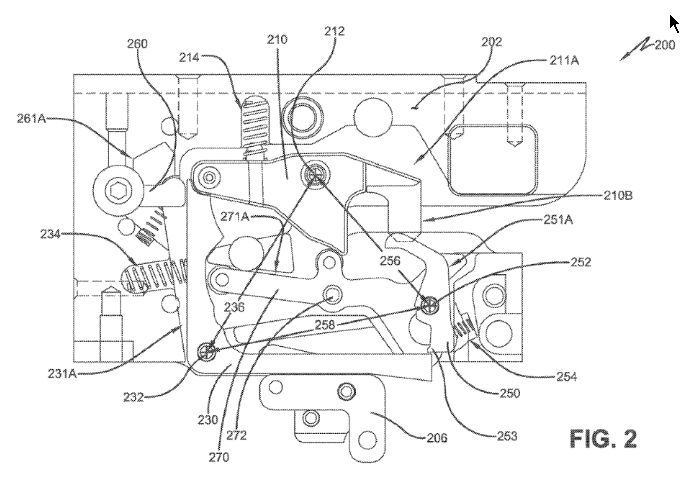
The patented method is engineered around a mobile, multi-stage trigger mechanism that interfaces directly with an internal winch assembly. Rather than being fixed rigidly to the stock, the entire trigger housing is designed to slide longitudinally along a guided rail system on the crossbow’s main beam. When a hunter wants to de-cock the weapon, they first apply a quick rotational input to a manually operated, pawl-less crank handle. This action tensions an internal tensile cable, which safely triggers a latch to release the sliding trigger housing from its locked position. From there, the user simply winds the crank handle backward; the clutch gear assembly subjects the reversing drive gear to a continuous internal damping load, allowing the stored energy of the bowstring to slowly and silently slide the trigger housing down the rail toward the un-cocked position under total mechanical restraint.

The US12,320,613 methodology represents a major evolutionary leap forward for modern hunting and competitive archery tools. By eliminating the loud clacking sound of traditional ratchets and introducing a true internal friction-plate clutch system, this technology enables modern compound and reverse-draw crossbow variants to be cocked and un-cocked seamlessly in complete silence. Ultimately, these integrated safety dampeners ensure that high-poundage weapons can be safely managed in tight quarters or tree stands, keeping hunters safe and protecting high-performance archery equipment from structural fatigue over time.


