
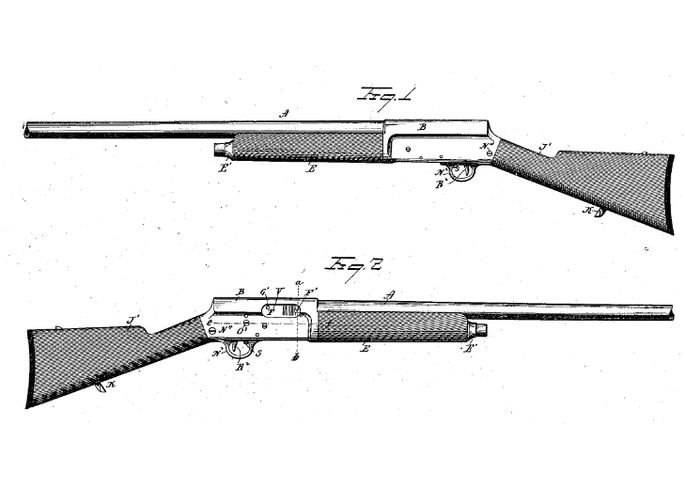
John M. Browning’s Recoil-Operated Breakthrough – US659,507
For generations, repeating shotguns and long guns depended entirely on manual mechanisms like pump-action, lever-action, or break-action setups. Early pioneers attempting to build self-loading firearms faced immense hurdles, often bogged down by mechanical complexity, excessive weight, and the severe stresses generated by heavy-duty shotgun shells. These older repeating configurations forced shooters to manually cycle the action every single time, slowing down follow-up shots and increasing operational fatigue. The cumbersome nature of these manual steps created a strong demand for a smoother, fully automated cycling method for hunters and competitive marksmen.

John M. Browning (From Wikipedia)
A massive turning point in repeating firearm history arrived on October 9, 1900, when U.S. patent US659,507 was officially awarded to master inventor John M. Browning for a groundbreaking recoil-operated mechanism. Assigned to protect his pioneering self-loading architecture, this design elegantly harnessed the physical force produced by firing a cartridge to power the entire reloading cycle. Instead of depending on human muscle or complicated gas bleed-off ports, Browning utilized the coordinated rearward momentum of both the barrel and the breechblock working in tandem to unlock, clear, and chamber the next round.
At its core, the patent details a true long-recoil operating system rather than a standard blowback or gas-piston layout. When a round is discharged, the barrel and bolt stay locked tightly together, traveling backward in unison over a distance that exceeds the actual length of the shell casing. During this movement, they compress the main operating springs positioned around the magazine tube. Once the system reaches its rearmost limit, the bolt is caught and held in place while the barrel independently slides back forward, kicking out the spent hull in the process. Finally, the bolt releases, rushes forward under spring tension, strips a fresh shell from the magazine, and locks firmly back into battery.

This iconic patent laid the groundwork for a revolutionary class of self-loading sporting arms, serving as the direct blueprint for legendary firearms like the Browning Auto-5—widely celebrated as the first commercially viable semi-automatic shotgun—and its sibling, the Remington Model 11. By cleanly channeling recoil energy along the firearm’s primary axis, Browning achieved unprecedented reliability, managed heavy shell loads efficiently, and introduced a level of automation that forever transformed the landscape of modern shotgun manufacturing.


