
Concealing the Canopy: The 2026 Sampson Three-Dimensional Camouflage Patent – US12,520,838
Three-Dimensional Camouflage Patent – US12,520,838
Early woodsmen and hunters relied strictly on flat textiles, natural brush, or stationary blinds to break up their silhouettes in the field. When elevated tree stands emerged decades ago, they revolutionized hunting by lifting the woodsman above the direct line of sight of game animals. However, this elevated advantage introduced a uniquely modern headache: how to safely and effectively obscure a human outline suspended against an open sky or a bare trunk. For generations, the only standard way to camouflage an elevated platform was to weave heavy, decaying natural branches into the metal framing or drape flat, mesh tarps around the base—a cumbersome, short-lived, and structurally rigid chore that often failed to mimic the three-dimensional depth of a natural canopy.

On January 13, 2026, a significant milestone in portable wildlife concealment was reached when U.S. patent 12,520,838 was issued to inventor Bruce Jason Sampson of Prince Frederick, Maryland. The patent, entitled “Camouflage Apparatus and Method of Use Thereof,” introduced a highly compactible, expanding artificial branch system engineered to clip directly into a tree’s trunk. This design provides immediate, dynamic depth to an elevated hunting setup without requiring the harvesting of live vegetation or adding burdensome weight to a hunter’s pack.

The Mechanics of Structural Expansion
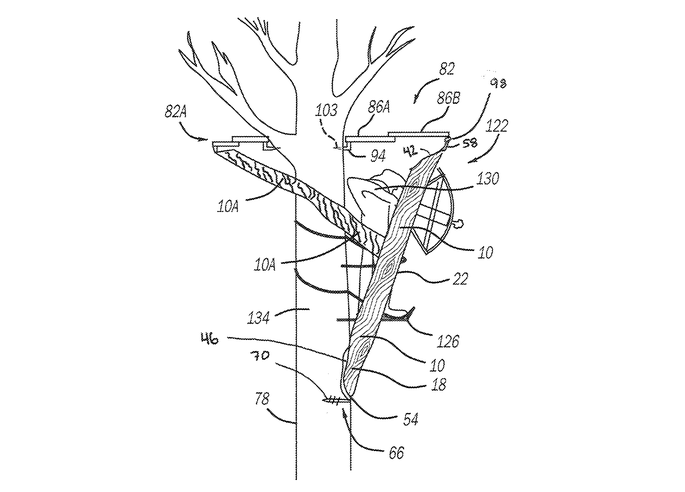
The patented architecture utilizes a lightweight, flexible fabric cover printed with a detailed tree bark pattern to form the outer skin of the artificial branch. Rather than depending on heavy, rigid framing materials, the structure relies entirely on an internal coil spring housed within the fabric’s enclosed space. When the system is compressed for travel, the spring is collapsed axially, drawing the ends of the fabric cover together and significantly shortening the assembly. Simple hook-and-loop fastening straps are wrapped around the compressed segments, securely locking the spring in place for compact storage and silent transportation.
To deploy the branch in the field, the hunter simply releases the fastening straps. The stored energy within the compressed spring automatically drives the ends of the cover apart, instantly maximizing the length of the branch. Because the outer diameter of the helix is marginally smaller than the inner diameter of the fabric, the expanding coils press outward against the internal surface of the cover. This radial tension keeps the fabric taut, maintaining a highly realistic, three-dimensional cylindrical or frusto-conical shape that accurately mimics a natural woodland limb.
Securement to the tree is achieved via a dual-anchor system designed to support the limb at a natural, upward angle. The base of the branch is secured near the tree stand platform via a heavy-duty lag bolt equipped with an integrated eyelet, which clips securely to a primary carabiner. The upper end of the branch terminates in a second carabiner that couples with an articulating, multi-link support arm.
This specialized support arm features a tapered, threaded auger bracket that bores cleanly into the bark. To lock the system’s angle against high winds, the arm utilizes an interlocking joint assembly featuring matching toothed collars. These collars mesh together under the weight of the limb, completely restricting unwanted rotation until the user manually lifts the link to adjust the setup.

Evolutionary Impact on Wilderness Concealment
The US12,520,838 methodology represents a major evolutionary leap forward for modern field concealment and seasonal hunting strategies. By engineering a frusto-conical spring variant where individual coils collapse flat into a single, zero-pitch plane, the patent enables full-sized, multi-foot structural branches to compress neatly down into a pocket-sized disc for silent transport.
Furthermore, the integration of reinforced pass-through holes along the fabric’s length allows secondary, smaller artificial limbs to clip directly onto the main spring core, giving outdoorsmen the ability to build custom, interlocking leaf canopies tailored to their specific environment. Ultimately, this system ensures that elevated tree stands can be seamlessly broken up in complete silence, protecting outdoorsmen from game detection while drastically reducing the footprint of modern hunting gear.


