
Setting the Stage for Modern Air Guns: The 1962 Crosman Carbon Dioxide Rifle Patent – US3,067,730
Early humans relied on their own breath, blowguns, and simple mechanical leverage to propel small projectiles long before the discovery of modern gunpowder. For centuries, the explosive expansion of burning chemical propellants remained the definitive way to launch a projectile from a handheld weapon. However, as technology matured, inventors realized that compressed gas could provide a clean, highly repeatable alternative for target shooting and sport. Early pneumatic air guns were a bit cumbersome, requiring tedious manual pumping before every single shot or relying on heavy, external air reservoirs that limited a shooter’s mobility. This changed dramatically with the introduction of commercial, disposable carbon dioxide (CO2) powerlets in the mid-twentieth century, which offered a dense, portable source of energy right inside the gun frame.
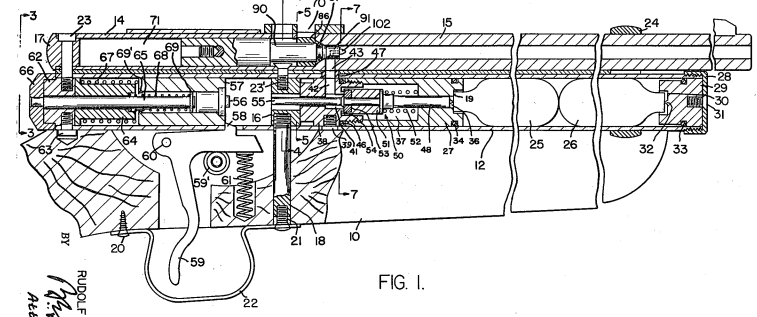
On Dec. 11, 1962, an important milestone in compressed gas firearm technology was reached when U.S. patent US3,067,730 for a gas-powered gun was obtained by Rudolph Merz and assigned to the Crosman Arms Company. The patent, entitled “Gas-Powered Gun,” introduced a highly efficient mechanism designed to regulate and deliver this onboard liquefied carbon dioxide gas. Specifically, the design utilized a built-in reservoir inside the stock’s hollow tube to hold one or more disposable (CO2) cartridges, making the rifle completely self-contained and exceptionally easy to handle for target shooting and amusement.
The mechanism was specifically designed to solve the problem of gas waste and pressure inconsistency that plagued earlier air guns. At the heart of the invention was a spring-biased hammer assembly that worked closely with the trigger and a normally closed poppet valve. When the user pulled the trigger, the hammer was released to strike a rod, which momentarily knocked the poppet valve open against its seating spring. This action permitted a precise, metered charge of pressurized gas to escape the reservoir, travel through an internal fluid passage, and enter the barrel directly behind a pellet. To chamber a new projectile, a manual breech bolt operated by a small knob was used to push a pellet from a carrying magazine into the firing position, after which the user manually pulled the hammer rearward to engage the trigger sear and re-cock the rifle.

The US3,067,730 pneumatic mechanism set the stage for many air gun patents to come. Since 1962, advancements in (CO2) and pre-charged pneumatic (PCP) air gun technology exploded. These advancements include: multi-shot rotary magazines that index automatically with each bolt cycle, integrated regulators that ensure identical gas velocity from the first shot to the last, and advanced seals capable of holding extreme pressures for extended periods, all designed to improve the shooter’s success in the field.


